
Festivals and the Constitution: The Legal Framework of Celebrating Festivals in India
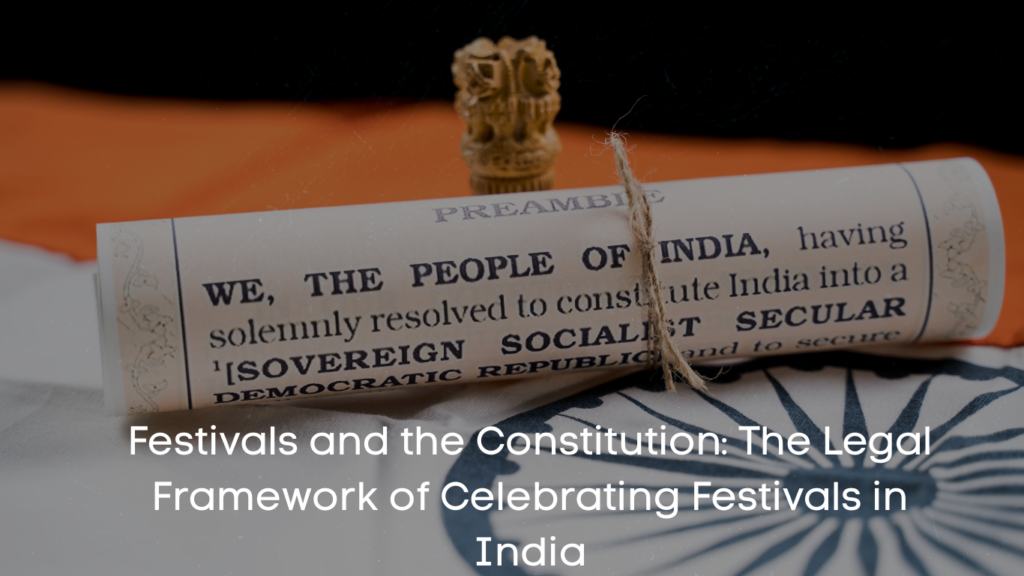
Festivals in India are often viewed as cultural or religious traditions existing outside the
sphere of law. However, within a constitutional democracy, even everyday practices such as
festival celebrations operate within a legal framework.
The Constitution of India provides the foundation that allows communities to celebrate their
traditions while ensuring that such celebrations respect public order, health, and the rights of
others.
- Religious Freedom
The most direct protection for religious festivals comes from Article 25 of the Constitution of India, which guarantees freedom of conscience and the right to profess, practise, and
propagate religion.
Festivals such as Holi, Diwali, and Christmas often involve rituals and community
participation that may fall within the scope of protected religious practices.
The Supreme Court clarified in The Commissioner, Hindu Religious Endowments, Madras v.
Sri Lakshmindra Thirtha Swamiar of Shirur Mutt that religion includes not only beliefs but
also rituals and observances regarded as integral to a faith. - Freedom of Expression and Assembly
Festival celebrations frequently involve public gatherings, music, and processions. These
activities are linked to the freedoms guaranteed under Article 19 of the Constitution of India.
Article 19 protects both freedom of expression and the right to assemble peacefully. Cultural
celebrations during festivals therefore often fall within the scope of these constitutional
freedoms, though they remain subject to reasonable regulation to maintain public order. - Cultural Rights
Festivals also contribute to preserving cultural identity. Under Article 29 of the Constitution of India, citizens have the right to conserve their culture.
Through shared rituals and traditions, festivals help transmit cultural practices across
generations and reinforce community identity. - Regulation and Public Welfare
While the Constitution protects the freedom to celebrate festivals, it also allows regulation in
the interests of public welfare. Judicial interpretation of Article 21 of the Constitution of India has recognised the right to a healthy environment, enabling authorities to regulate issues such as noise levels and public safety during celebrations.
Conclusion
The constitutional framework does not treat celebration and regulation as opposing forces.
Instead, it protects the freedom to celebrate cultural and religious traditions while ensuring
that such celebrations respect the rights and well-being of others.
Festivals therefore illustrate how constitutional principles operate not only in courts and
legislatures but also in everyday social life.